Cummins ISC 8.3L 2008 F350

Ford

F-Series

2008

0

Signup or Login to like and comment
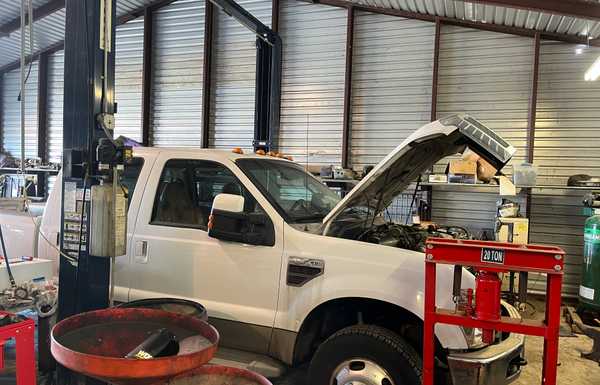
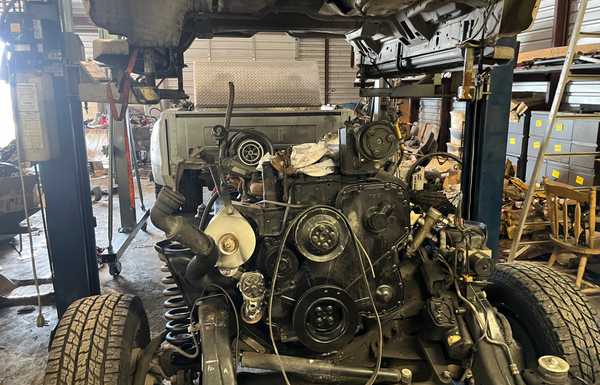
Step 1.  This was before the idea of an engine swap was on the horizon.  Preparing to pull the cab and see what horrors await on this 6.4L with a dead hole.
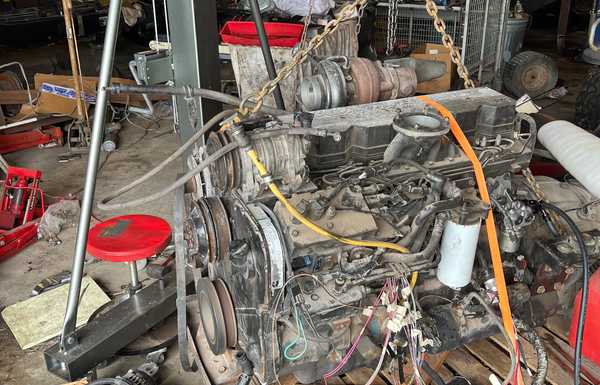
One freshly plucked Cummins ISC 8.3L with an Allison 3000 transmission.
Got it home, and decided to give it a test run.  Lots of temporary wiring, and voila.  it took a little fiddling to get the throttle sensor to work, but my home made (from ebay parts) transmission wiring worked on the first shot.
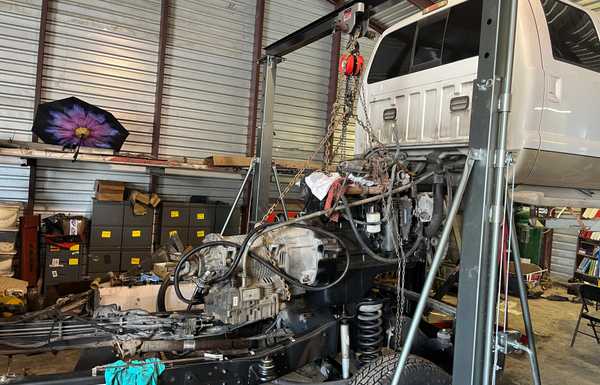
One of the first test fits
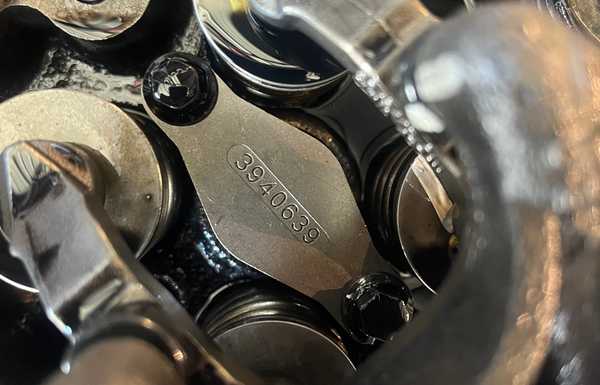
Checking the valves, since I had the cover off anyway.  Some were pretty far off for a fresh (Cummins Reman less than 10,000 mile) engine.
I did a thing.  Lots of tedious masking and prep work.   It was a complete mess before I started.  I'm surprised it cleaned up as well as it did.
One of the first cab fitting, many , many more to come.
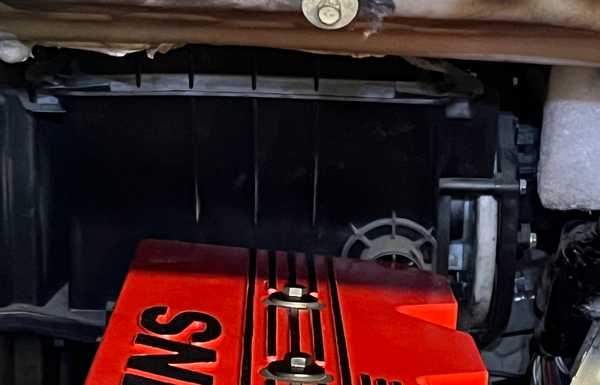
This is taller and wider, and longer than a 5.9/6.7  Wider wasn't a problem.  Longer was challenging.
One of the first cab fittings.  It's crooked, and not level.  I know.
Firewall has been removed to make space.
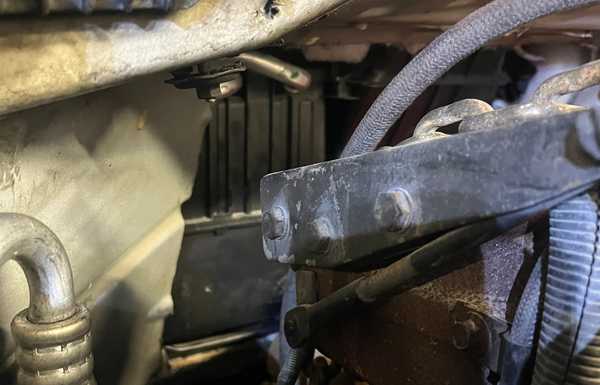
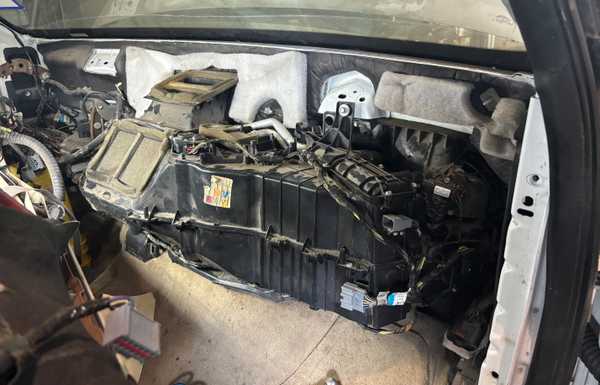
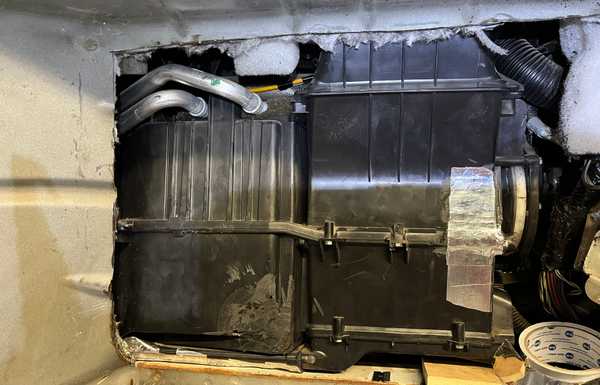
With the fire wall cut out, I could shave every bump off the back of the HVAC box.  I gained up to 2" in this area. It was critical to make the valve cover fit.
Modified firewall going back in.  This was formed from the outside while the HVAC box was still attached, giving the shape you see here.  This was the maximum allowable space that would still let me keep the HVAC box.  AC is not negotiable.   I live in Texas.
Side profile of the new firewall.   It moved back about 2" up high, which went a long way towards making this possible.
Finished welding and seam sealed from the outside.
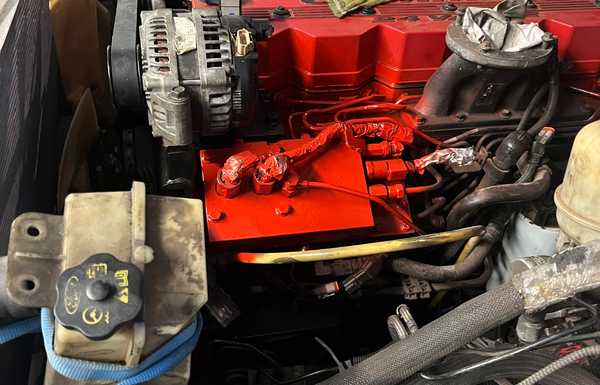
I decided that red was the way to go.  This is a picture of the belt routing that I worked out.  I built custom brackets for the AC compressor (from a 2009 E350 I had on the shelf), and the standard Ford 6.4L alternator.  The big alternator on the left of the picture came with the engine, and will be turned into a welder/dedicated 12V feed for my travel trailer.  The Ford alternator will serve as the normal truck alternator.    Power steering/brakes will run off a small pump that bolts to the back of the air compressor.
This took a massive amount of time to get to this point. It all fits from front to back.  I had to modify the fan support, and fan pulley to get me the last inch or so of space I needed.  As you can see from the previous picture, the fan pully is from the Ford 6.4L.  It is much thinner and smaller than the Cummins one.  Smaller means more fan RPMs, which is important, since the engine doesn't turn as fast as the 6.4L (2200 RPM max).
I also had to modify the fan to move it back an inch or so.  This is the final location of the engine. Now to start building front mounts.
New front engine mount crossmember.  2x4 1/4" tubing, 1/2" plate uprights, and 2.5"x3/8" angle gussets.  the large spreader bar between the engine front mount and the crossmember came with the engine.  It was part of the Spartan Coach that the engine came out of.  No need to reinvent the wheel.  The spreader bar was designed to use a square block engine mounts that are still available on eBay as NOS items.  I don't want 25 year old rubber, so I found that 2000 V10 Dodge trucks and Vipers use an identical mount, and they are available new.
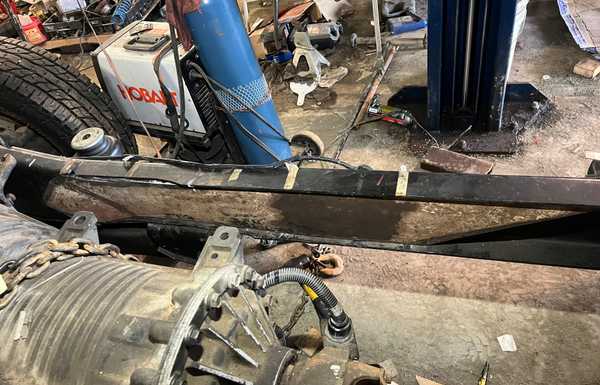
First step on the rear mounts is boxing this frame.  A little CAD (Cardboard Aided Design).
3/8" plate cut and ground to fit snug.  The front is bent to accommodate the shape of the Ford frame using a shop press.
A better view of the new steel.
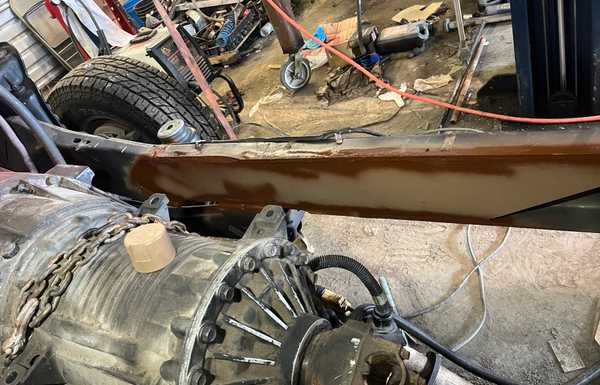
Welded, and painted with left over paints to keep it from rusting till I can get some more black paint.
Same procedure on driver's side.
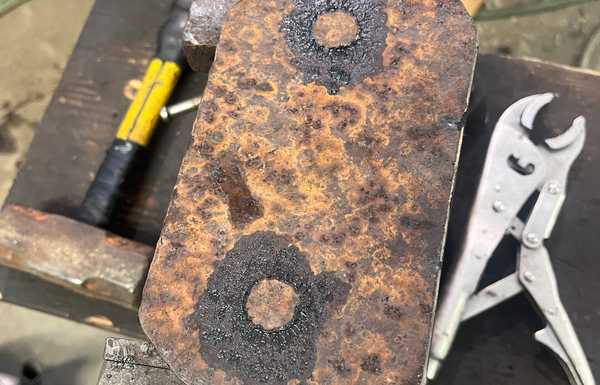
First rear engine mount in progress.  I'm using some 1/2" thick cedar fence picket as a stand in for 1/2" plate steel.  It's easier to mock up and sturdier than cardboard..
This starter is a behemoth.  Size 12 (American) shoe for scale.  There are smaller options that will work on the 8.3L, but this one came with he engine and it fits.  Luckily the bell housing has the starter on the driver's side, otherwise I would have to have a hood stack.  Lol
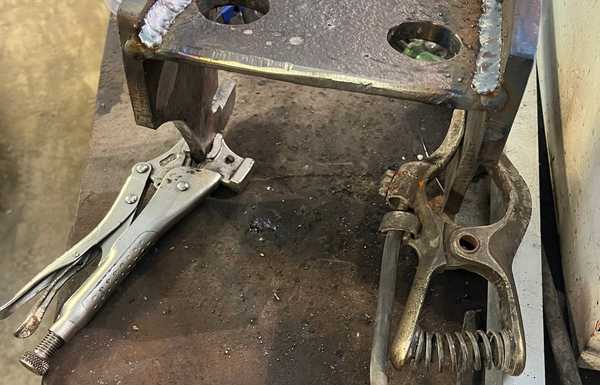
After tacking together on the frame, I removed the mount for more welding.  I am not a welder, but I am confident that this will work just fine.  There was good bevels cut with the plasma cutter, and ground cleanly, and welded with several passes.  My little 180 amp welder can't do any more than this.  

Incidently, Rich just made mounts for his Hybrid Land Cruiser ( on Youtube), and I saw that his design for mounts was pretty much the same as what I had just made.  I feel pretty good about that.  His were just smaller (1/4" plate instead of 1/2").
RIght rear engine mounts in progress.  All the steel I'm using is recycled from things I've found around town or on the ranch.
Right rear engine mount mocked up using the same wooden spacers that I used on the other side.  The wood is used for vertical clearance checking.
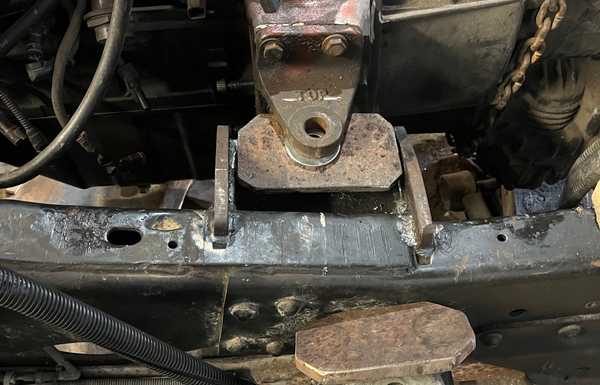
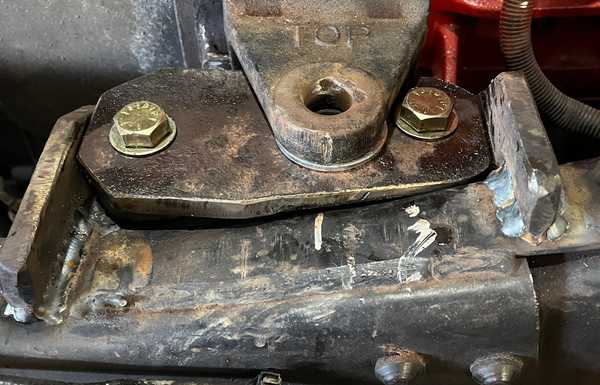
Driver's side engine mount welded to frame, and rubber puck style engine mounts in.  It takes 2 part #‎M20310K4H.  There  is a spreader  plate over the pucks that the actual engine mount bracket will bolt to.
Same on the passenger side, but it is a little different shape since it is much closer to the frame rail, and the frame rail is a different shape.
I dabbed some brake grease on the top of the pucks to mark exactly where to drill the holes.
After drilling the bolts slotted in perfectly.  2 grade 8 5/8" bolts go through the pucks, and a 7/8" grade 5 bolt for the engine mount to spreader plate.  I think 92,000 pounds of yield strength should be sufficient.
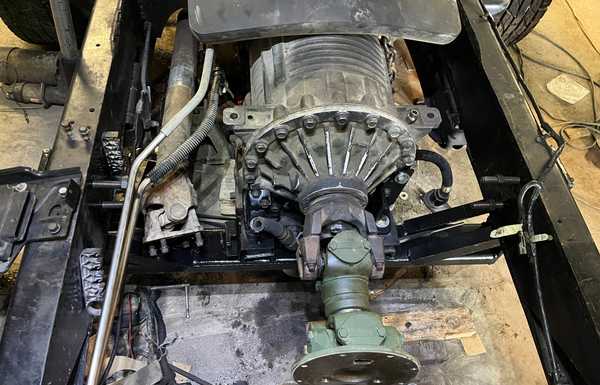
Same on the other side.  Once I let the entire engine/trans down onto the mounts for the first time, it settled more than I thought it would.  I have ben suspending the rear of the trans with a ratchet strap stretched between the frame rails till now.  It threw off the angle at which the engine sat, so I added a 7/8" washer as a spacer under each mount, and it went exactly back where I want it.
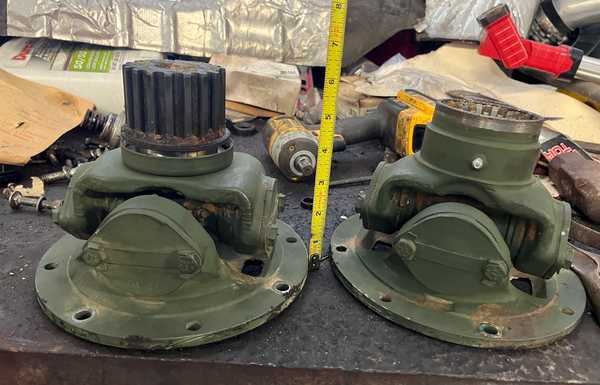
I found this shaft to use as my jackshaft between the transmission and transfer case.  It was pricy, but I couldn't build something better for the money.  It is really really short, which is perfect
I changed one of the U joints to match the style for a yoke.
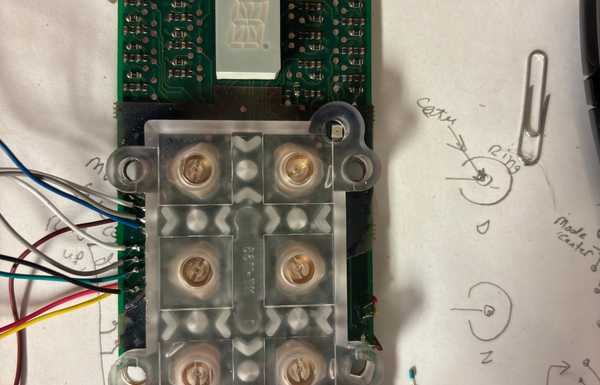
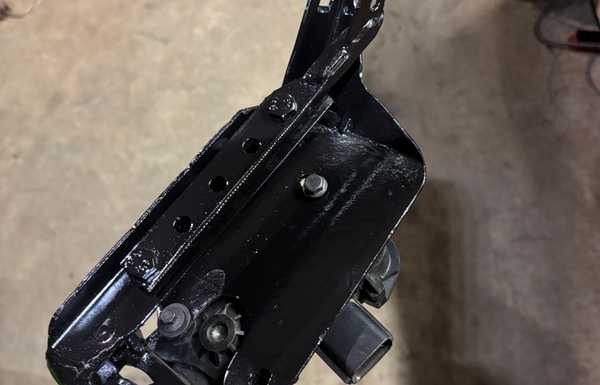
A bit of a change.  I spent a bit of time modifying the Allison shifter to allow me to trigger it remotely. It is too large to mount it nicely anwhere in the cab.  It will go in he bottom of the center console, with a muuch smaller remote on the dash.  Ideally, I am going use a micro controller to trigger it using the ordinary Ford gear shift.  The Allison shifter will still be doing the work, but it will be triggered through an ESP32 or Arduino.
wired soldered and glued in place.  The 16-segment display will also be extended out to run a second numerical display on the dash board.  I found a green display to match the Ford dash board display color.
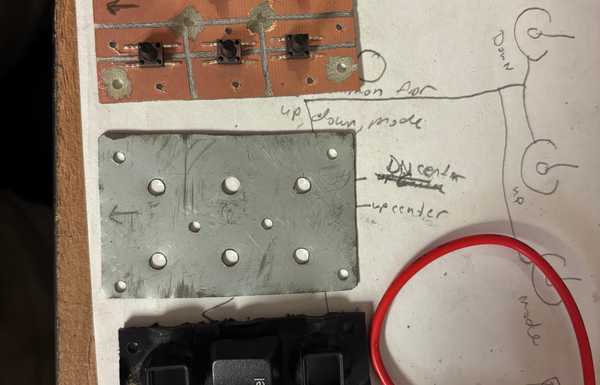
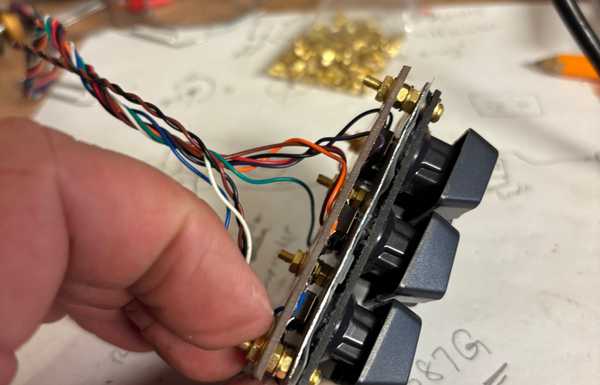
This is a prototype of a button panel remote control for the transmission.  It's made from P keyboard parts and a crudely cut circuit board.
The finished prototype.  It works perfectly.  If I can't make the Arduino idea work properly, I'll find a nicer set of keys to make this fit with the aesthetic of the Ford interior.  

This proved that the extra 4' of ribbon cable that runs from the center console to the dash didn't cause a problem making he shifter work.
Changing gears to work on the interior.  Painted the re-shaped firewall.
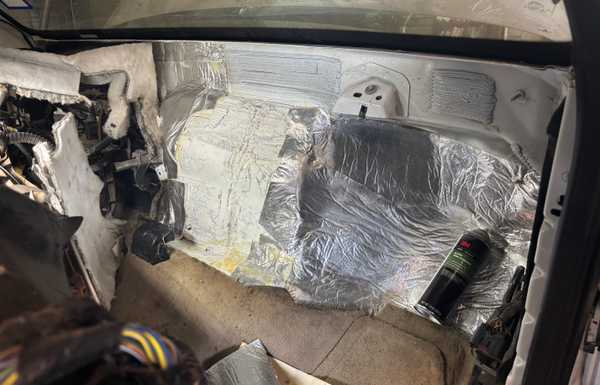
Extra insulation.  I wasn't able to add more to the center, since I moved the firewall back about 2" or so.  The 6.4l engine had a screaming hot turbo right outside the center section, and a HVAC box on the inside.  With the Cuummins, all the heat is on the right side.  
I was able to fit the standard Ford insulation back in the middle, so there is some there.
It still fits!
After moving the firewall back and shaving all the bumps off the back of the HVAC box, I lost two of the mounts for the HVAC box.  It still felt sturdy, and the dash board sandwiches it in tightly, so I'm not worried about it.
This is from were I cut out the firewall and started shaving the HVAC box down.
Basically how the HVAC box looked after I got done shaving it.  After this, I tacked the firewall back in as far back as I could possibly make it.  Next I removed the dash and the HVAC box to finish the welding on the inside and outside.
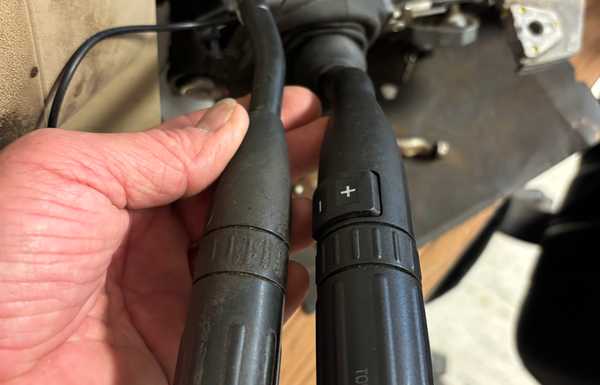
Replaced the 2008 shifter with a 2016 shifter.  The buttons on the 2016 shifter will be used to control he Allision shifter.  +, - will be shift up, shift down, and the tow/haul will be the "Mode Button on the Allison shifter.
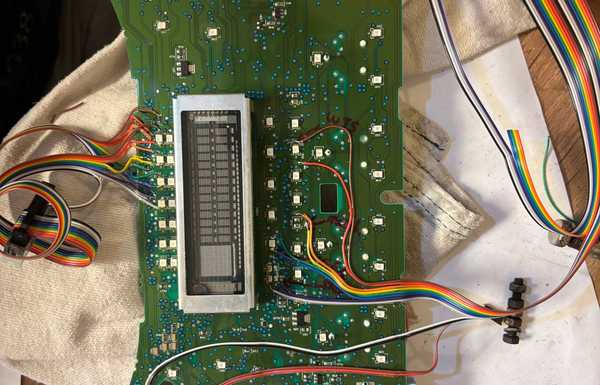
Next mods are for the instrument panel. On the left side I have re-routed the shift indicator LEDs to be used as inputs for the Arduino Allison interface.  On the right, I have cut the traces to the various indicator LEDs.  Then wires were added to let me connect them to the Cummins ECM.  I also added LEDs for the Cummins "Maintenance" light and "Stop Engine" light.  There were unpopulated spots on the board that I used for those.
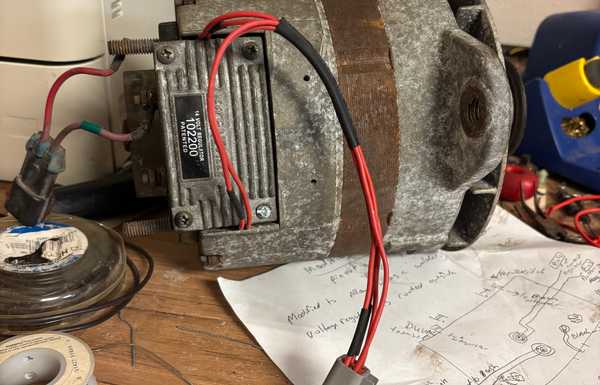
I modified this Leece Neville alternator to be used as a welder.
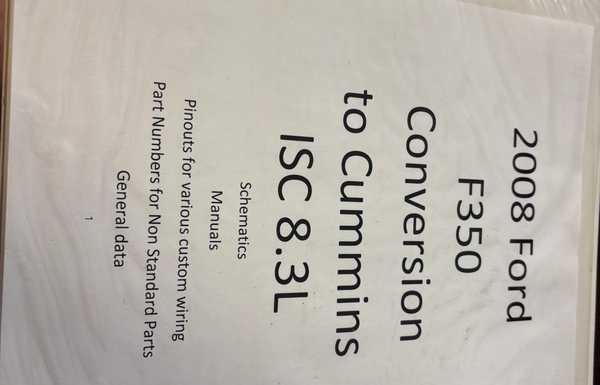
One of the things I have been doing is documenting everything.  I have had to go back to this many times after forget how I did something.  Especially on the wire harnesses I made.  My goal is  to make it so that someone else could maintain this if I'm not around.
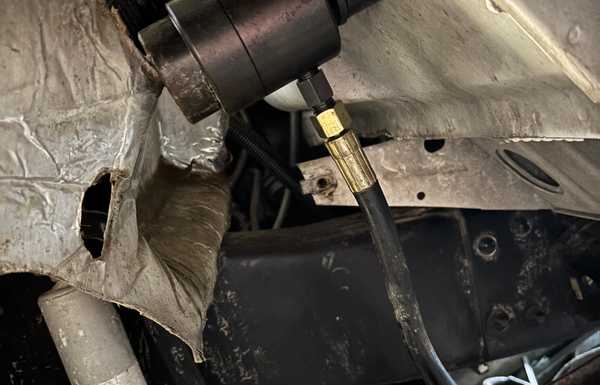
It's always fun when you can break out the hydraulic knock out punch.  I'm adding bulkhead connectors for various wiring.
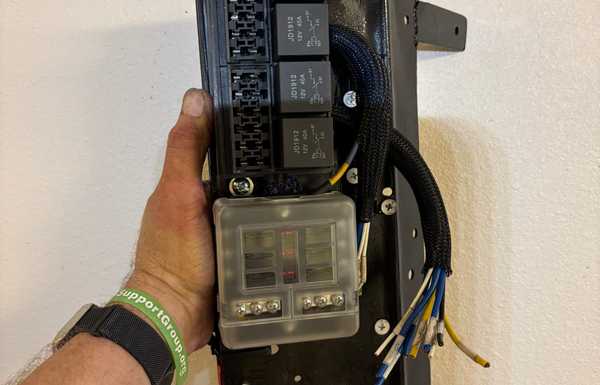
Fuse and relay panel for the Cummins side.
The backside with the grid heater relays.
modified the Ford petal to pull a cable for the Cummins throttle position sensor.
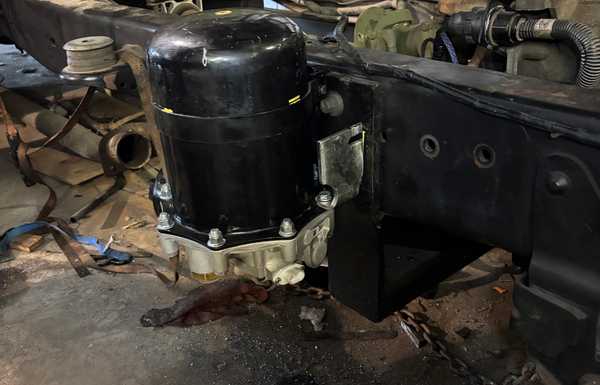
Air dryer installed.  I will have on-board air, since I have a compressor on the engine.
Wet air tank mounted.  It is a DOT rated tank.  Actually the tank is sitting on jack stands, but that is where it mounted after i got it finished.
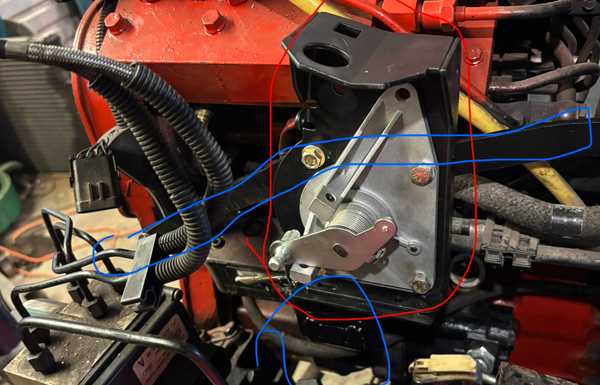
I found that a Dodge TPS sensor and throttle quadrant will work on this ISC. It is mounted a little weird because it wasn't designed for it.  The vertical mounting allows the cable to move a little as the adjustable petals in Ford move back and forth.
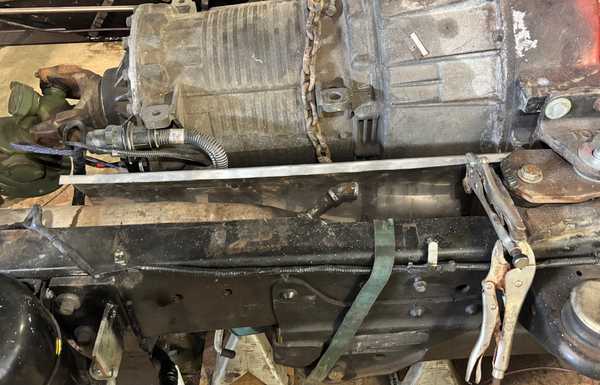
Constructing a heat shield to protect the transmission  wiring
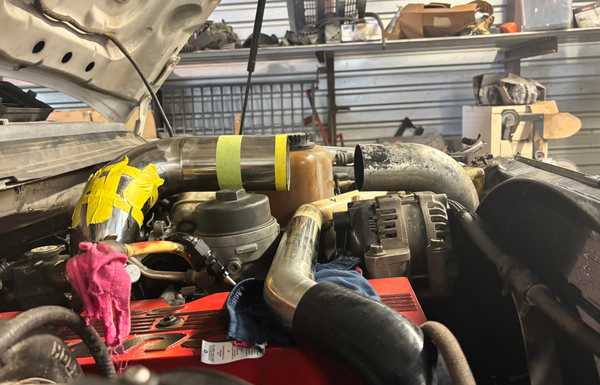
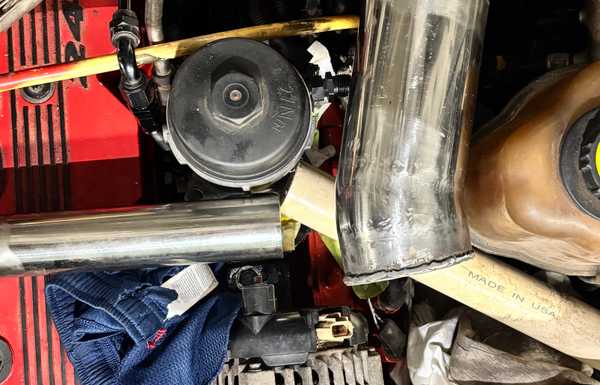
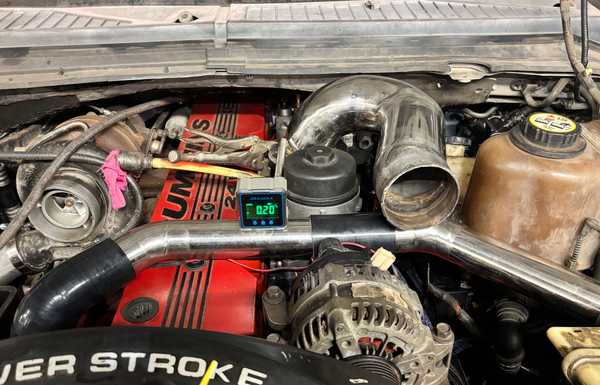
Building an intake neck and intercooler piping.
Checking hood clearance with a bit of masking tape and red grease..
The nearly finished product.
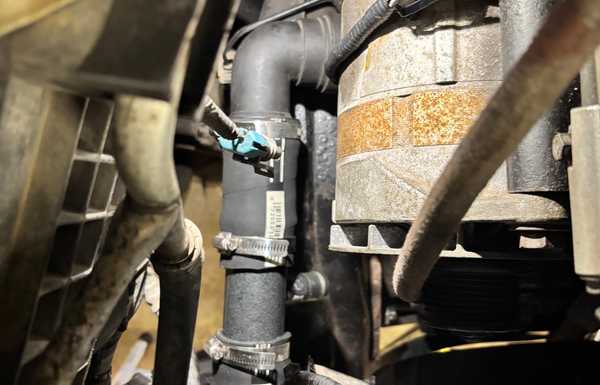
The upper radiator pipe had to go behind the upper alternator.  I could run it over the top of the alternator, but I didn't want to have to burp the coolant if it developed a bubble in the high part.  The way I have it, it should be self burping through the normal degass bottle setup.
The lower hose was super simple.  I used a Ford 90' quick connect.
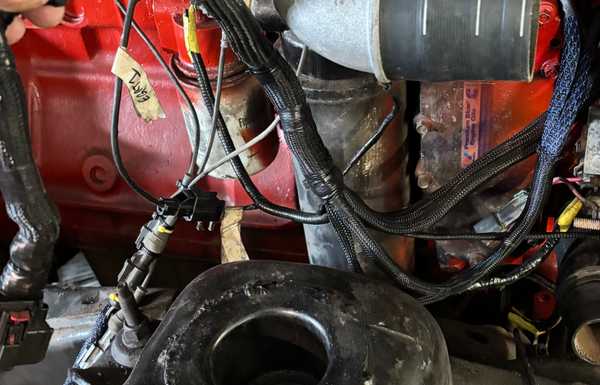
Sensor wiring harness installed
Harness secured, and strain relief made from old pre-formed heater hose bends.
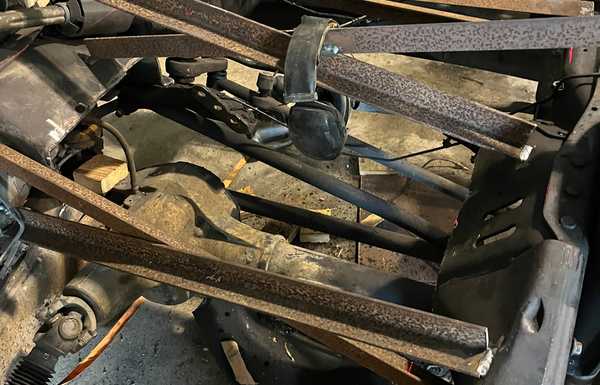
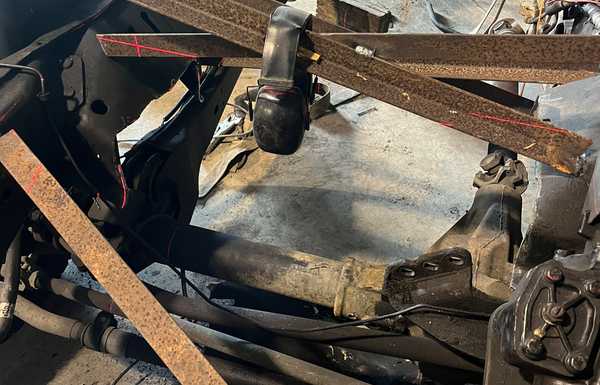
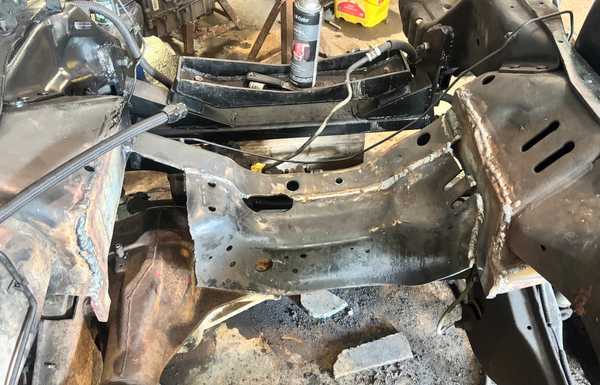
This one is from way back.  I really didn't want to do a body lift, so i opted to lower the engine crossmember.  I cross braced the frame, and cut out the crossmember.
You can see the laser lines where I cut the crossmember.
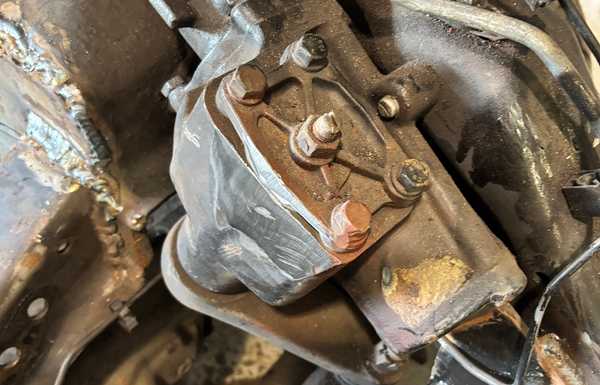
Back to current time.  I had to remove a little of the extra cast iron on this steering box to give me more clearance between the box and the engine timing cover.  I used a 9" grinder while the engine was in place, and finally with the engine off the frame, I can clean it up with a flap disc.
You can see the plates I added to lower the crossmember.  Initially, I only used the front portion of the crossmember to mock up the engine in the frame.  Now that I know how much space I have, I can add most of the rest of it back in.  It has lost 2" of crossmember (front to back measurement).  There is just enough clearance above the axle, and probably enough around the front diff.  I didn't like the shape of the crossmember on the left side, so i cut it out, and it will be replaced with much a much straighter piece.  The front engine crossmember is also welded and bolted to the frame, which should help stiffen the frame after the crossmember modifications.

Mods

It used to have a tuner and delete, but now it will have a Cummins 8.3L.

Build story

This was a pretty ordinary 2008 King Ranch F350 6.4L. I tuned it pretty early on, and had a lot of fun with it till it blew up at about 190,000 miles. To be fair, I wasn't kind to it. I got a new (Ford Reman) engine. While still tuned (To a more reasonable level), I did baby the truck afterwards. Strict maintenance, watching temperatures, good fuel additives. It broke again at about 280,000 miles. I considered getting a better built 6.4L, but those aren't cheap, and there's no guarantee that it won't suffer the same fate. So Cummins it is. I considered the normal route with a 5.9 or 6.7L. The price for an engine, swap parts, etc was pretty steep.

I watched Rich's videos on the F-350, and was inspired to go the road less travelled. I found a guy locally that was selling a donor 8.3L Cummins engine an Allison transmission for the right price. After some measurements, I decided it was indeed possible. Now I'm neck deep on frame modifications and building engine mounts.
Map of location
View Projects Map

Comments

To leave a comment on Cummins ISC 8.3L 2008 F350:

Login or Signup